Gmail and Outlook can't send faxes on their own. Here's how email-to-fax actually works — and why most people end up choosing a simpler alternative.
No account · No subscription · Done in 60 seconds
Email-to-fax services act as a converter between two incompatible systems: your email client and the recipient's fax machine. Here's the full pipeline, from the moment you hit send to when the document prints on the other end.
Understanding this process explains two things: why there's no “free” way to fax from email (someone has to run fax servers and phone lines), and why things break — any link in that six-step chain can fail.

Once you've chosen a service and created an account, here's the process for sending a fax through your email client.
Most services (eFax, Fax.Plus, HelloFax, iFax) require account creation before you can send. Have your email and payment info ready.
Check your account dashboard or welcome email. The format is usually faxnumber@servicedomain.com — each service uses a different domain.
Works with Gmail, Outlook, Apple Mail, Yahoo — any standard email client.
For example: 5551234567@faxservice.com. Remove all dashes, spaces, and parentheses from the fax number. Include country code for international faxes (e.g. 441234567890@service.com for UK).
Some services use the subject line as the cover page title. Others ignore it — check your service's documentation. You can type a cover message in the email body if the service supports it.
PDF, DOC, DOCX, JPG, PNG, and TIFF are generally accepted. Keep total attachment size under the limit (usually 20MB). Click Send and wait for a confirmation email.
The most frequent reason faxes fail: using the wrong domain for your service, leaving spaces or dashes in the fax number, or forgetting the country code. Double-check the format in your service's dashboard before sending anything urgent.
Most services offer a free trial to get you signed up, then push you toward monthly subscriptions. Here's what you'll actually pay once the trial ends.
| Service | Free Trial | Per-Page Cost | Monthly Plan | Account Required |
|---|---|---|---|---|
| eFax | Limited | Subscription only | $16.95–$19.95/mo | Yes Subscription |
| Fax.Plus | 10 free pages | $0.99–$1.99/page | $5.99–$19.99/mo | Yes Freemium |
| HelloFax | 5 free pages | $1.99/fax | $9.99+/mo | Yes Freemium |
| iFax | Free trial | Subscription only | $8.99–$24.99/mo | Yes Subscription |
A $20/month subscription costs $240 per year even if you only send 3 faxes. QuickFax's pay-per-fax pricing means a 4-page fax costs $6 total — no monthly commitment.
These aren't hypothetical — they're the real frustrations users report after trying email-to-fax:
I tried emailing my fax but I forgot the format and it bounced back three times.
I sent the email but I don't know if the fax actually went through until I get a confirmation email hours later.
I created an account for a one-time fax and now I keep getting charged $15/month.
My attachment wasn't accepted — I had to convert it to PDF first just to send one page.
Need to send a fax right now?
No account. No subscription. $1.50/page. Live delivery confirmation.Instead of routing your fax through email with special formatting, QuickFax lets you send a fax online directly from your web browser — in about 60 seconds, with no account required.
$1.50/page · No account · No subscription · Live delivery status
Send your fax in 60 seconds.
No account · No subscription · $1.50/page · Live delivery confirmation.Email-to-fax is one path. Here are the other options, with an honest take on each.
Upload directly through a website — no email middleman. Faster feedback, clearer status, and no formatting rules to remember. The easiest way to send a fax for most people.
Download an iOS or Android app, scan with your camera, send through the app. Convenient for mobile-first users but usually requires account creation and subscription plans.
Walk in with your document and pay $1–2 per page. Requires travel, operates during business hours only, and you can't always verify the machine is working until you get there.
Built into Windows, technically free — but requires a fax modem and active phone line connected to your PC. Most people no longer have this hardware, making it impractical for the vast majority of users.
If you found this article because you need to fax something to the IRS, a medical office, or a legal department — a direct web-based fax service is faster, simpler, and has no account or formatting requirements. It's the best way to send a fax for occasional needs.
Need to send a fax right now?
No account. No subscription. $1.50/page. Live delivery confirmation.“Fast, secure, the price is right! This site is a blessing for those who rarely have to send a fax.”
Stephen from California
“By far the easiest and most convenient internet fax service I have ever used. Highly recommend.”
John from New Mexico
“I loved that it doesn't require a subscription or a free trial. I just got in and faxed what I needed to.”
Tom from Mississippi
“This was my first time sending a fax this way, and it was very easy. I will definitely use this again. Was much easier then going to a store.”
Elizabeth from Arizona
Trusted by thousands to fax IRS, SSA, legal, medical, government documents, and more.
Send a Fax Online →No subscription. $1.50/page.
No. Faxing from Gmail or Outlook requires a third-party service — you can't type a fax number in the To field and have it work. You either sign up for an email-to-fax service or use a web-based alternative like QuickFax that doesn't involve email at all.
No. Email-to-fax services maintain fax servers and phone lines on your behalf — that's the whole point. You also don't need a fax machine with web-based services like QuickFax, which lets you fax without a fax machine from any phone or computer.
Most email-to-fax services charge $10–25/month on subscription plans, or $0.99–$1.99 per page on pay-as-you-go plans. QuickFax charges a flat $1.50 per page with no subscription, no account, and no hidden fees — making it one of the most cost-effective options for occasional senders.
Reputable services encrypt transmission, but email itself has limitations — your document sits in your sent folder and your email provider can technically access it. Direct web services like QuickFax offer equivalent or better security because the document never touches your email system: it's encrypted on upload and deleted after delivery.
Most email-to-fax services accept PDF, DOC, DOCX, JPG, PNG, and TIFF, with a size limit of around 20MB. When in doubt, convert your document to PDF first — it's universally accepted and produces the most consistent fax quality.
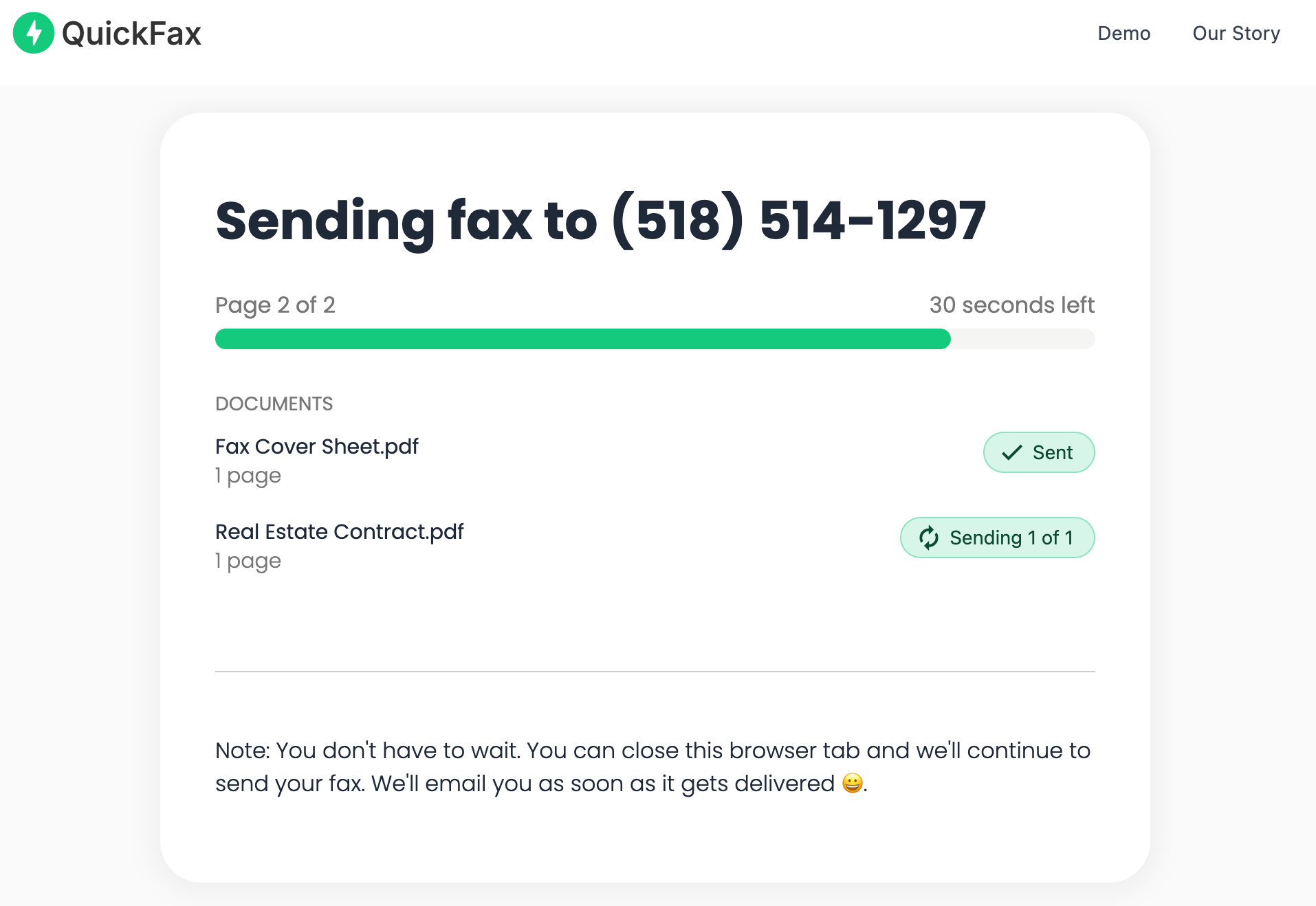
Email-to-fax services send a confirmation email when the fax succeeds or fails — you wait passively for it. Services like QuickFax show a live status page so you watch delivery happen on screen in real-time. You also receive an email confirmation, but you don't have to sit there refreshing your inbox to find out.
No — a dedicated fax number is only required if you want to receive faxes. For sending only, you just need access to a fax service. Note that some subscription plans bundle a receiving number whether you want it or not. QuickFax is send-only with no subscription, so you only pay for what you actually use.
Most services support international faxing, but you'll need to include the country code in the email address format (e.g. 441234567890@service.com for a UK number), and international faxes typically cost $3–5 per page.
Just enter the fax number, upload your documents, and send.
Send a Fax Online →